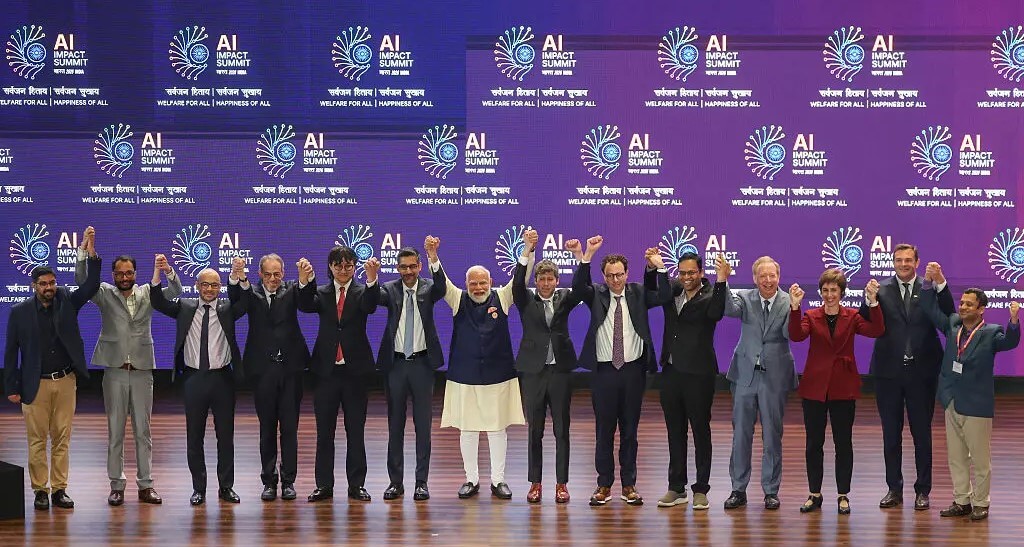
The India AI Impact Summit 2026 in New Delhi represents far more than a conventional technology conference; it marks a strategic inflection point in the global artificial intelligence landscape. By convening policymakers, multinational technology leaders, investors, academic institutions, and multilateral organizations under one forum, the summit reinforced the growing perception that AI is no longer a sectoral technology but a foundational layer of economic systems, governance models, and geopolitical influence. As the world transitions into an AI-driven economic era, the summit underscored how emerging economies are increasingly shaping the direction of technological governance and innovation rather than merely adopting frameworks designed by advanced economies.
Beyond symbolism, the summit illustrated how AI discussions are shifting from innovation showcases to policy architecture and economic strategy formulation. The conversations increasingly reflected a long-term systems view of AI as critical national infrastructure, comparable to energy grids, telecommunications networks, and financial systems. This reframing signals that global forums on AI are evolving into platforms where economic futures, digital sovereignty, and cross-border regulatory norms are actively negotiated, rather than simply discussed in abstract technological terms.
The Shift from AI Adoption to AI Sovereignty
One of the most significant undercurrents of the summit was the transition in global discourse from AI adoption to AI sovereignty. Countries are no longer only discussing how to use AI but are strategically focused on owning the infrastructure, data ecosystems, and talent pipelines that power next-generation AI models. India’s positioning at the summit highlighted its ambition to build sovereign AI capabilities through domestic compute infrastructure, indigenous datasets, and localized AI models tailored to diverse linguistic and socio-economic contexts.
This shift toward AI sovereignty also reflects a broader geopolitical recalibration in the digital economy, where technological dependency is increasingly seen as a strategic vulnerability. Nations are investing in domestic AI stacks, including foundational models, cloud ecosystems, and national data frameworks, to reduce reliance on external platforms. As AI becomes embedded in governance, defense, finance, and healthcare systems, sovereign control over algorithms and data flows is emerging as a key determinant of long-term economic and strategic resilience.
This shift is particularly important in a world where AI capabilities are increasingly tied to national competitiveness. Governments and corporations are recognizing that reliance on external AI ecosystems may create technological dependencies that affect economic resilience, cybersecurity, and innovation autonomy. The summit’s policy dialogues therefore emphasized the need for open yet strategically secure AI ecosystems that balance global collaboration with national technological self-reliance.
Moreover, the discussions highlighted that sovereignty does not imply isolation. Instead, the emerging model involves interoperable ecosystems where countries collaborate on standards, research, and ethical frameworks while retaining domestic control over critical AI infrastructure. This nuanced balance between openness and autonomy is likely to define the next phase of global AI development.
Expanding Public-Private Collaboration in the AI Economy
Another defining feature of the summit was the deepening integration between public institutions and private technology enterprises. Discussions repeatedly highlighted that the scale of AI transformation especially in areas like healthcare, finance, infrastructure, and education requires unprecedented public-private coordination. Government-backed AI missions, regulatory sandboxes, and research grants were presented as key mechanisms to accelerate innovation while maintaining regulatory oversight.
This collaborative approach is also reshaping how innovation cycles operate. Instead of isolated R&D pipelines, governments are increasingly acting as innovation catalysts by funding early-stage research, enabling pilot deployments, and providing digital public infrastructure on which private enterprises can build scalable AI solutions. Such models reduce market entry barriers for startups and create a more inclusive innovation ecosystem.
Large technology companies also emphasized collaborative innovation models, where startups, universities, and research labs are integrated into broader AI value chains. This ecosystem-driven approach is expected to drive faster commercialization of AI research, enabling breakthroughs in sectors such as precision medicine, climate modeling, smart manufacturing, and financial analytics. The summit’s collaborative tone signaled a transition from isolated innovation silos toward globally interconnected AI ecosystems.
In addition, cross-border partnerships announced during the summit indicate that AI innovation is increasingly transnational. Strategic alliances between research institutions, global tech firms, and policy bodies are accelerating the co-development of AI technologies, reinforcing the idea that the future of AI will be shaped by collaborative networks rather than single-country dominance.
AI Infrastructure as the New Economic Backbone
A major strategic theme emerging from the summit was the centrality of AI infrastructure as a driver of economic growth. Discussions extended beyond software innovation to include semiconductor supply chains, hyperscale data centers, cloud infrastructure, and high-performance computing clusters. Policymakers and industry leaders stressed that access to compute power is becoming as critical as access to energy or capital in the digital economy.
This infrastructure-centric narrative reflects a structural shift in how nations measure technological readiness. Compute capacity, data availability, and advanced networking are increasingly viewed as economic multipliers capable of accelerating productivity across industries. As a result, governments are prioritizing AI infrastructure investments as part of broader industrial and digital transformation strategies.
India’s emphasis on scaling GPU capacity, expanding data center networks, and strengthening digital public infrastructure reflects a broader global trend: nations are investing heavily in AI infrastructure to secure long-term technological leadership. This infrastructure-centric approach is expected to catalyze innovation across industries while also attracting foreign direct investment and strengthening domestic startup ecosystems.
Furthermore, AI infrastructure development is expected to generate significant spillover benefits, including job creation in digital engineering, cloud operations, cybersecurity, and semiconductor logistics. Over time, these investments may contribute to the emergence of regional AI clusters that function as innovation hubs within the global digital economy.
Ethical Governance and the Global Regulatory Architecture
Ethical and responsible AI governance remained central to the summit’s agenda, particularly as AI systems become more autonomous and deeply embedded in societal decision-making processes. Leaders advocated for globally interoperable regulatory frameworks that address algorithmic bias, data privacy, transparency, and accountability. The discussions suggested that future AI governance will likely evolve into a hybrid model combining national regulatory sovereignty with international ethical standards.
This governance focus reflects growing awareness that unchecked AI deployment could create systemic risks, including misinformation amplification, labor displacement, and ethical misuse of automated decision systems. Policymakers emphasized proactive regulation that fosters innovation while ensuring safeguards against unintended societal consequences.
The summit also placed strong emphasis on inclusive AI, highlighting the risks of digital inequality if AI development remains concentrated within a few advanced economies. By advocating accessible and affordable AI solutions, the forum positioned technology as a tool for equitable development rather than exclusive economic advantage. This narrative aligns with the broader push for “human-centric AI,” where technological progress is measured not only by efficiency gains but also by societal impact.
Additionally, ethical AI frameworks discussed at the summit extended to global south inclusion, multilingual AI development, and accessibility-focused design. These priorities signal a shift toward democratizing AI benefits across diverse socio-economic and cultural contexts.
AI’s Transformational Role Across Core Economic Sectors
Sector-specific dialogues at the summit revealed how AI is rapidly transitioning from experimental deployments to mission-critical infrastructure across industries. In healthcare, AI-powered diagnostics, federated health data platforms, and predictive analytics are expected to enhance early disease detection and healthcare accessibility. In finance, AI-driven risk modeling, fraud detection, and algorithmic decision systems are reshaping the architecture of global financial services.
This sectoral transformation is also driving the emergence of AI-native business models where automation, predictive intelligence, and real-time analytics are embedded into core operational frameworks. Enterprises are increasingly redesigning workflows around AI capabilities rather than simply layering AI onto existing systems.
Similarly, manufacturing and supply chain sectors are increasingly leveraging AI for predictive maintenance, autonomous logistics, and real-time operational optimization. Agriculture, another key focus area, is witnessing the rise of AI-enabled precision farming, climate risk forecasting, and yield optimization technologies that could significantly enhance food security in emerging economies. Over the long term, these cross-sector applications indicate that AI will function as a horizontal technology layer influencing productivity, cost efficiency, and innovation simultaneously across multiple industries.
Talent, Workforce Transformation, and the Future of Jobs
A recurring theme throughout the summit was the profound transformation AI will bring to global labor markets. Leaders acknowledged that while AI will create new high-value jobs in data science, robotics, and AI governance, it will simultaneously disrupt traditional employment structures across administrative, analytical, and operational roles.
This transformation is expected to redefine skill hierarchies, placing greater emphasis on cognitive, creative, and interdisciplinary capabilities. As routine and repetitive tasks become increasingly automated, the workforce will need to adapt toward higher-value roles that involve strategic thinking, AI supervision, and complex problem-solving.
The summit highlighted the urgency of large-scale reskilling initiatives, digital literacy programs, and AI-focused education reforms. Universities, vocational institutions, and corporate training programs are expected to play a central role in preparing the workforce for an AI-native economy. Importantly, policymakers stressed that workforce adaptation strategies must be proactive rather than reactive to prevent structural unemployment and widening income inequality. Furthermore, discussions emphasized lifelong learning ecosystems supported by governments and corporations, ensuring continuous workforce evolution in response to rapidly advancing AI technologies.
India’s Strategic Role as a Bridge Between Developed and Emerging Economies
A defining narrative of the summit was India’s unique geopolitical and economic positioning as a bridge between advanced and developing nations in the AI ecosystem. With its vast developer base, rapidly expanding digital infrastructure, and strong startup culture, India is increasingly seen as a scalable innovation hub capable of delivering cost-efficient AI solutions for global markets.
This positioning is further strengthened by India’s experience in building large-scale digital public infrastructure, which provides a foundation for inclusive AI deployment across sectors such as governance, finance, and healthcare. The summit reinforced the idea that scalable and affordable innovation models developed in India could be replicated across other emerging economies.
This bridging role extends beyond technology deployment to governance diplomacy. By advocating collaborative AI frameworks that include voices from the Global South, India is contributing to a more decentralized and inclusive global AI governance architecture. This approach could reshape how global AI standards are formulated in the coming decade.
It also enhances India’s soft power in global technology diplomacy, positioning the country as both an innovation partner and a policy influencer in shaping the ethical and strategic direction of global AI adoption.
Geopolitical Competition and the AI Arms Race
The summit also underscored the intensifying geopolitical competition surrounding AI leadership. Nations are racing to dominate key AI domains such as advanced chips, foundational models, quantum computing integration, and defense-oriented AI systems. This competition is not purely technological but deeply economic and strategic, as AI capabilities increasingly influence global trade, defense preparedness, and diplomatic leverage.
The emergence of AI as a strategic asset is accelerating a new form of technological arms race where leadership in compute, talent, and research ecosystems determines geopolitical influence. Governments are increasingly integrating AI into national security doctrines, economic policies, and industrial strategies.
However, alongside competition, the summit promoted the idea of cooperative competition where countries compete in innovation while collaborating on ethical frameworks, safety standards, and cross-border research initiatives. This dual dynamic reflects the evolving nature of global technological diplomacy in the AI era. Such a framework may reduce fragmentation in global AI governance while still allowing competitive innovation, ultimately fostering a more stable and balanced technological ecosystem.
Investment Supercycle and Startup Ecosystem Acceleration
From an investment perspective, the summit signaled the continuation of a global AI investment supercycle. Venture capital firms, sovereign funds, and institutional investors are channeling significant capital into AI startups, infrastructure providers, and deep-tech research ventures. India’s startup ecosystem, in particular, is expected to benefit from increased global funding flows, strategic partnerships, and innovation incentives announced during the summit.
This surge in capital allocation reflects investor confidence that AI will drive the next multi-decade productivity cycle across global economies. Investments are increasingly targeting foundational AI models, enterprise AI platforms, and vertical AI solutions tailored to industry-specific challenges.
The convergence of capital, policy support, and technological innovation is likely to accelerate the emergence of AI unicorns, specialized research hubs, and vertically integrated AI enterprises. This investment wave will also strengthen adjacent sectors such as cloud computing, cybersecurity, semiconductors, and digital platforms. Over time, the multiplier effect of AI investments may redefine global venture capital patterns, with emerging markets capturing a larger share of deep-tech funding than in previous technological cycles.
Long-Term Implications for the Global Economic Order
Ultimately, the India AI Impact Summit 2026 reflects a broader structural transformation in the global economic order. Artificial intelligence is rapidly evolving into a core pillar of national development strategies, corporate competitiveness, and global governance frameworks. The summit demonstrated that leadership in AI will not be defined solely by technological breakthroughs but by the ability to align policy, infrastructure, talent, and ethical governance into a cohesive innovation strategy.
This alignment is expected to shape future global economic hierarchies, where AI-ready economies gain disproportionate advantages in productivity, innovation, and strategic influence. Nations that successfully integrate AI into industrial policy, education systems, and digital infrastructure will likely emerge as leaders in the next economic cycle.
As AI becomes deeply embedded in economic systems, summits of this scale will increasingly function as strategic coordination platforms shaping global technological norms. The outcomes of the India AI Impact Summit suggest that the future AI landscape will be multipolar, infrastructure-driven, ethically governed, and deeply integrated into every layer of the global economy marking the beginning of a new era where AI strategy and national strategy are becoming fundamentally inseparable.
Related Articles: https://ciovisionaries.com/category/economic-news/
Related Blogs: https://ciovisionaries.com/category/business/