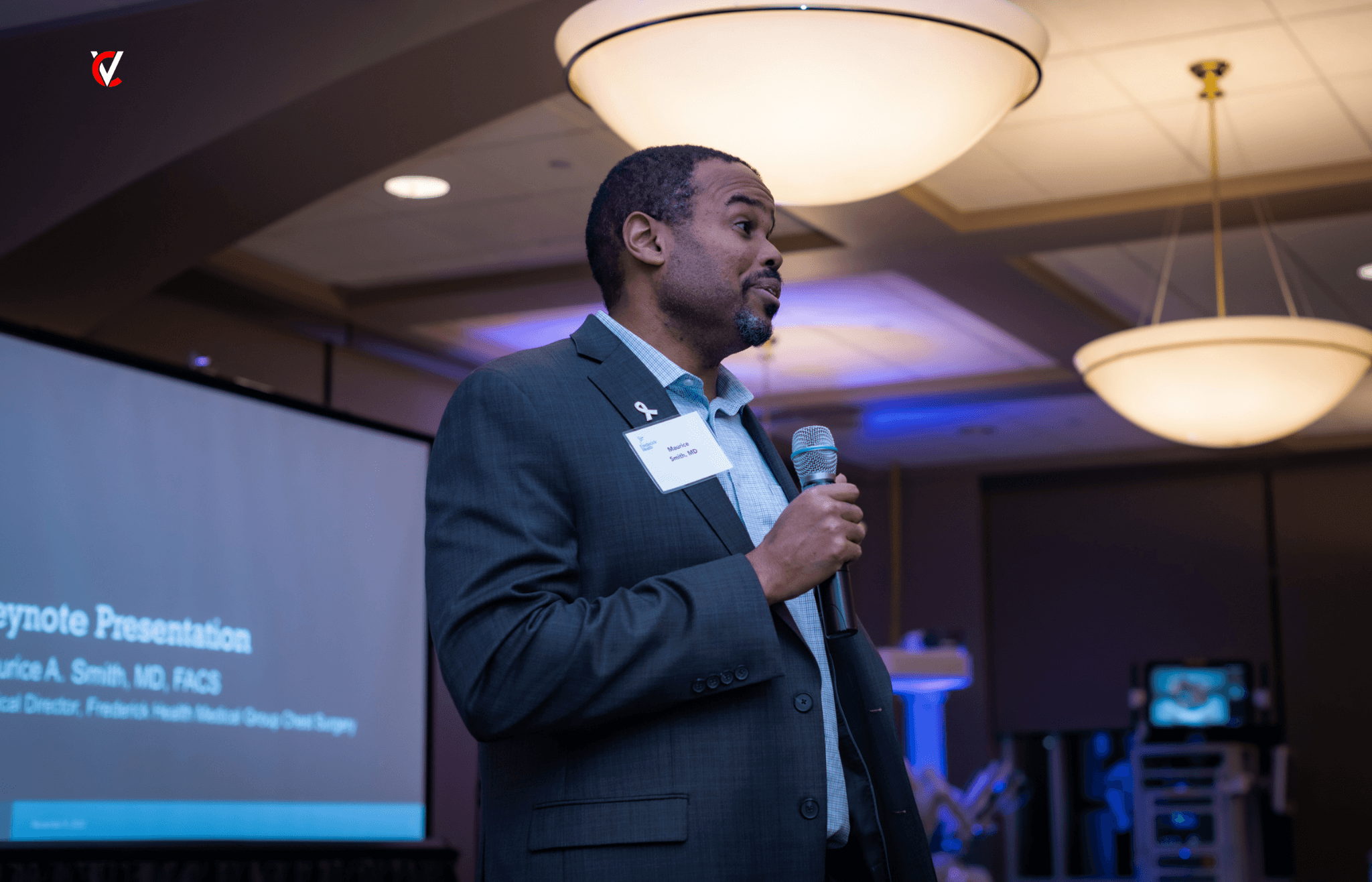
In today’s rapidly evolving healthcare landscape, visionary leadership requires more than medical expertise. It demands compassion, resilience, innovation, and an unwavering commitment to serving both patients and future generations of healthcare professionals. Few embody this balance as effectively as Maurice Smith, Board of Directors member and Chief of Staff at Frederick Health.
Recognized as Maryland’s 2025 Physician of the Year, Maurice has built a remarkable career that seamlessly blends clinical excellence with strategic leadership. As a thoracic surgeon and Medical Director for Chest Surgery, he continues to shape the future of patient-centered care while mentoring the next generation of medical leaders.
Healthcare, for Maurice, has always been driven by passion, purpose, and a deep commitment to improving lives.
A Dream That Began at Five Years Old
Some careers are discovered over time. Others begin with a single defining moment.
For Maurice, that moment arrived at the age of five while watching a heart transplant on PBS television. Fascinated by the complexity and life-saving impact of surgery, he immediately knew the path he wanted to pursue.
Encouraged by his parents, particularly his mother, a science teacher, he immersed himself in learning about the human body from an early age. From anatomy books at the library to participating in frog dissections alongside his mother’s students, his curiosity only deepened with time.
Decades later, Maurice continues to approach medicine with the same passion and enthusiasm that first inspired him as a child.
Service at the Core of Leadership
When asked to define the philosophy behind his leadership approach, Maurice uses one powerful word: Service.
To him, healthcare leadership extends far beyond hospitals and clinics. It means reaching patients where they are in schools, churches, and local communities and ensuring healthcare remains compassionate, accessible, and deeply human.
Beyond patient care, Maurice is deeply committed to developing future healthcare leaders.
Maurice strongly believes that investing in future healthcare professionals creates long-term impact far greater than individual accomplishments alone. Whether speaking to elementary school students about science, providing shadowing opportunities to high school students, or mentoring young physicians, he views mentorship as one of the most fulfilling aspects of his career.
This philosophy was heavily influenced by his father, Dr. Frederick Smith, PhD, who served as a university Department Chair in Leadership and Higher Education. Watching former students return years later to thank his father for shaping their careers left a lasting impression on him and helped define his own approach to leadership.
That philosophy of investing in others continues to shape Maurice’s leadership approach today.
Building Leadership Through Clinical Excellence
Before becoming a healthcare executive and board leader, Maurice focused intensely on mastering his craft as a clinician.
During his residency at the Medical College of Georgia, he earned the institution’s inaugural Resident of the Year award across all medical disciplines. That achievement led to an opportunity to meet with the hospital system’s Chancellor and President, where Maurice asked an important question: How does one become an effective healthcare leader?
The answer he received became foundational to his career: “Focus on clinical excellence first.”
That guidance became a defining principle throughout Maurice’s career.
Over time, Maurice’s reputation for exceptional patient care, collaborative leadership, and reliability earned him increasing opportunities within healthcare administration. What began with committee involvement evolved into leadership positions including Chair of the Department of Surgery and ultimately Chief of Staff and Board of Directors member at Frederick Health.
Even with growing executive responsibilities, he continues to prioritize direct patient care, believing strong healthcare leadership must remain grounded in clinical experience.
Recognition Beyond the Operating Room
In 2025, Maurice was honored as Maryland’s Physician of the Year with an achievement he views not as an individual milestone, but as recognition of the collective efforts of the Frederick Health team and surrounding community.
The award generated tremendous local pride throughout Frederick, Maryland, with the story featured prominently on the front page of the Frederick News-Post. Patients still bring newspaper copies for autographs, sharing how meaningful it was to see their community represented on a statewide stage.
The overwhelming community response highlighted the powerful human connection at the heart of healthcare.
Compassion as a Clinical Strategy
In high-pressure healthcare environments increasingly shaped by technology and efficiency metrics, Maurice remains deeply committed to preserving empathy in medicine.
He frequently reflects on a quote by Maya Angelou: “People will never forget how you made them feel.”
For Maurice, compassionate communication is fundamental to exceptional patient care. While advanced surgeries and innovative treatments may save lives, patients often remember most clearly the compassion, communication, and reassurance they received during vulnerable moments.
Before each patient interaction, he reminds himself that every individual is someone’s parent, child, sibling, or grandparent. That mindset shapes the way he communicates, listens, and leads.
Simple gestures being present, sitting down during consultations, and ensuring patients fully understand their care create trust that technology alone can never replicate.
Leveraging Technology to Improve Outcomes
As healthcare increasingly embraces digital transformation, Maurice has also been at the forefront of integrating data-driven tools into patient care.
At Frederick Health, advanced EMR systems now help identify at-risk populations for lung cancer screening by analyzing smoking histories and patient data gathered during routine visits. The organization also utilizes automated systems to flag incidental lung nodules discovered through CT scans ensuring patients receive timely follow-up care that might otherwise have been missed. These innovations have already produced measurable improvements in early-stage lung cancer detection rates.
Maurice believes technology should enhance not replace the human side of healthcare.
Redefining Collaborative Cancer Care
One of Maurice’s most impactful contributions has helped develop Frederick Health’s multidisciplinary lung cancer clinic with an integrated care model designed to streamline treatment while reducing patient anxiety.
Under this system, every patient benefits from coordinated support involving thoracic surgery, oncology, radiation oncology, social work, clinical research teams, and dedicated nurse navigators.
Cases are reviewed collaboratively before patients arrive, ensuring specialists remain aligned on treatment recommendations and next steps.
The results have been significant:
- Faster treatment timelines
- Earlier-stage cancer interventions
- Improved patient satisfaction
- Reduced confusion and anxiety
- Greater access to clinical trials and advanced therapies
Maurice views interdisciplinary collaboration as a critical driver of modern patient-centered care.
Addressing the Growing Challenge of Physician Burnout
Maurice is equally passionate about one of healthcare’s most urgent industry concerns: physician burnout. He believes the COVID-19 pandemic accelerated emotional exhaustion across the profession, intensifying workforce shortages and administrative pressures on providers nationwide.
At Frederick Health, leadership has responded proactively by establishing physician wellness initiatives, implementing engagement surveys, and investing in technologies designed to reduce administrative burden.
Ambient listening tools, workflow management systems, and team-based support structures help improve efficiency while allowing physicians to focus more fully on patient care. For Maurice, addressing provider burnout is both a human and organizational imperative.
Measuring Success Through Legacy
Despite numerous professional achievements, Maurice defines success differently from most healthcare executives. For him, true leadership success is measured through the accomplishments of those he mentors and inspires.
Over the years, he has helped guide students into surgery, supported physicians stepping into leadership roles, and encouraged mentees to pursue national opportunities within medicine.
Creating a legacy of leadership, mentorship, and service remains one of Maurice’s greatest aspirations.
Looking Ahead: The Future of Healthcare Innovation
As medicine continues evolving, Maurice sees enormous potential in precision medicine, targeted therapies, ctDNA monitoring, blood-based cancer screening, and artificial intelligence.
Within thoracic oncology specifically, he believes AI-assisted radiologic and pathologic assessment technologies will become increasingly sophisticated and widely adopted in the coming decade. At the same time, Maurice stresses the importance of ethical and responsible innovation in healthcare.
When paired with human expertise and compassionate care, he believes AI can help healthcare organizations improve outcomes while addressing growing physician shortages.
Advice to Future Healthcare Leaders
For young physicians and emerging healthcare leaders, Maurice offers simple but powerful advice: “Find your passion and pursue it.”
Maurice believes passion is one of the defining characteristics of impactful healthcare leaders.
In his view, purpose-driven professionals naturally bring resilience, energy, and excellence into their work. He also encourages regular self-reflection, mindfulness, gratitude, and proactive attention to burnout symptoms, recognizing that meaningful leadership requires not only professional success, but personal balance as well.
A Vision Rooted in Humanity
At a time when healthcare systems worldwide are navigating unprecedented transformation, Maurice Smith continues to lead with a rare combination of surgical excellence, strategic vision, compassion, and humility.
Beyond titles and accomplishments, Maurice’s legacy is defined by compassion, leadership, and meaningful impact. And after nearly five decades of pursuing the dream first sparked by a televised heart transplant, Maurice is still just getting started.
Related Blogs: https://ciovisionaries.com/articles-press-release/